If you want your brand to be cited in ChatGPT, the data points to two places: your own product pages, and the external listicles and review sites that compare you with alternatives. Blog posts, news articles and videos matter far less than most content plans assume.
Promptwatch tracks which page types ChatGPT Search cites. Their August 2026 data puts product pages at 28.7% of classified citations, almost three times the next type.
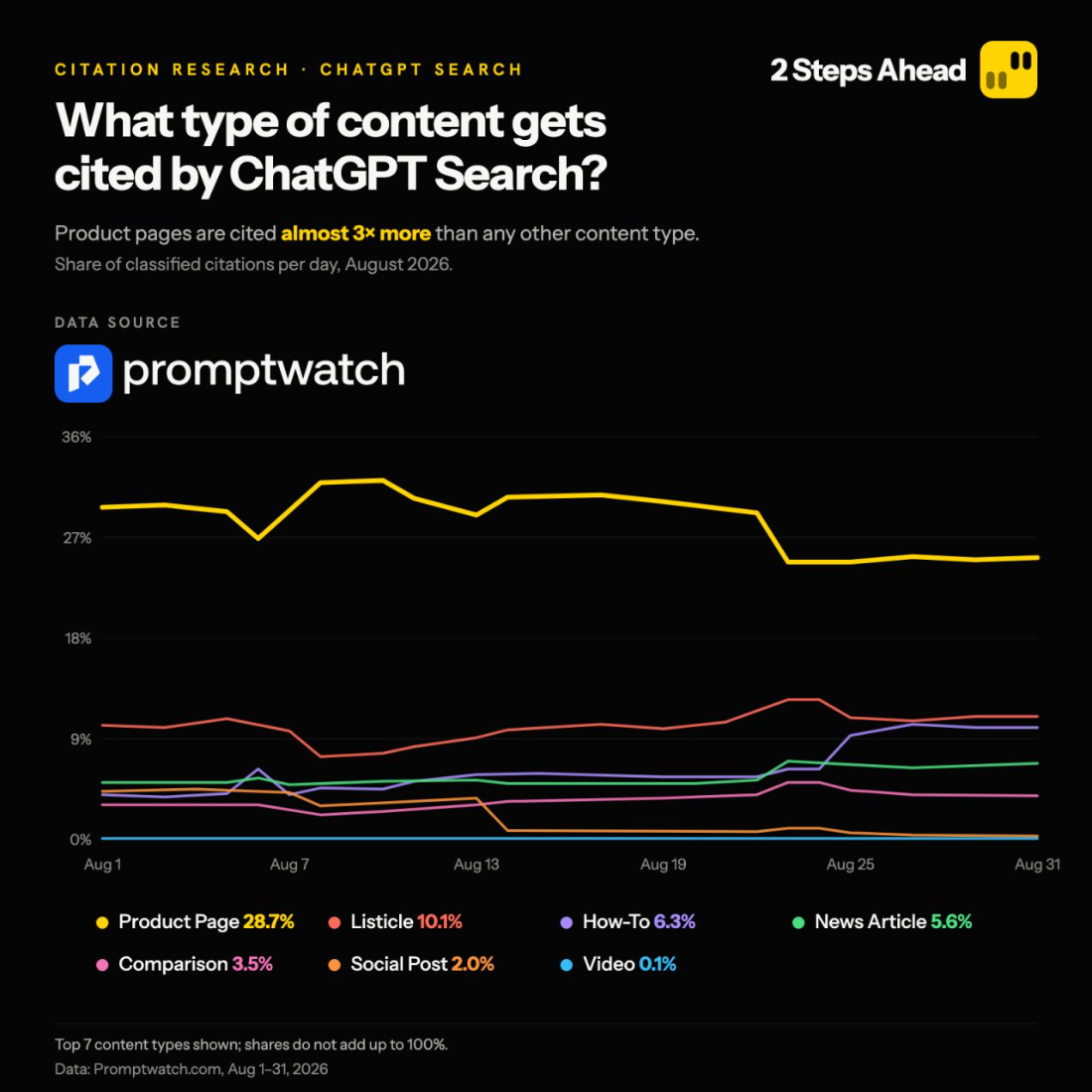
What the numbers say
| Content type | Share of citations, Aug 2026 |
|---|---|
| Product page | 28.7% |
| Listicle | 10.1% |
| How-to | 6.3% |
| News article | 5.6% |
| Comparison | 3.5% |
| Social post | 2.0% |
| Video | 0.1% |
Source: Promptwatch, 1 to 31 August 2026. Only the top seven content types are shown, so the shares do not add up to 100%. Promptwatch’s research groups listicles and review sites together at roughly 14%, which is why that figure differs from the listicle line in the chart.
Two things stand out. Product pages sit at the top all month, and they are a page type you fully control. Listicles and review sites come second, and those you only partly control.
What to do with your own product pages
A product page that gets cited is one a model can lift an answer from without guesswork.
- Put the key conclusion, definition and answer in the first section. Do not make a model read through a hero and three feature blocks to find out what you do.
- Match buyers’ questions and add fan-out queries. An assistant rarely runs one search. It splits a question into several, so the page should answer the follow-ups too: pricing, integrations, alternatives, fit.
- Publish pricing and technical information openly. Gated or vague pages give a model nothing to quote.
- State who it is, and is not, for. Clear boundaries make it easier for an assistant to recommend you for the right prompt and leave you out of the wrong one.
- Support the page off-site. A product page alone is not enough, which is where the second group comes in.
What to do about listicles and review sites
You do not own these pages, but you can influence whether you are on them.
- Build a list of tracked prompts per market. The buying prompts in Dutch, German or Swedish are not translations of the English ones, and the cited pages differ.
- Find the most cited pages for those prompts in ChatGPT. These are the listicles and review sites that actually feed the answers, not the ones with the best domain rating.
- Target those pages and get your brand included. Sometimes that is free, through a pitch, a data point or a correction. Sometimes it is paid. Either way you now know which pages are worth it.
If you run your own listicles or review sites
Remove fake authors and made-up bios. Anthropic and Google both updated their usage policies recently, and invented expertise is the kind of thing those updates are aimed at. The policies are public:
One caveat: a citation is not always a visit
A cited page and the link ChatGPT shows can be two different things. In some cases ChatGPT draws on a specific product page but links to the site’s homepage, and the overlap between cited pages and outbound URLs can be low. If you only measure referral traffic, you will undercount how often you are being used as a source. Track citations by prompt, not just clicks.
Where to start
Pick the ten prompts a buyer would actually type to shortlist you, check which pages ChatGPT cites for them, and compare that list with your own product pages. The gaps are usually obvious within an hour.
If you want that done for your market, a free audit shows which pages are cited for your prompts and where you are missing.
Frequently asked questions
What type of content does ChatGPT cite most? According to Promptwatch’s August 2026 data, product pages, at 28.7% of classified citations. Listicles are next at 10.1%, followed by how-to content and news articles.
Do blog posts get cited by ChatGPT? Yes, but how-to content and news articles each account for a much smaller share than product pages. A blog post helps most when it answers a question your product page does not, and when it links the reader back to the product.
How do I get included in listicles and review sites? Track the prompts your buyers use, find which listicles and review sites ChatGPT cites for them, and approach those publishers directly. Some inclusion is free, some is paid.
Why does ChatGPT link to my homepage instead of the page it cited? Cited pages and the URLs shown to users do not always match. This is a known quirk, so measure citations by prompt and not only referral traffic.